
The Last Slave Ship Was a Luxury Yacht
In 1858, nearly fifty years after the United States officially outlawed the transatlantic slave trade, a luxury yacht named Wanderer arrived on the coast of Georgia carrying 409 Africans who had been kidnapped from the Congo region and transported across the Atlantic. Although Congress had banned the importation of enslaved Africans in 1808 and later classified participation in the transatlantic slave trade as piracy, the voyage demonstrated how legal prohibitions could be undermined when influential individuals chose to ignore them.
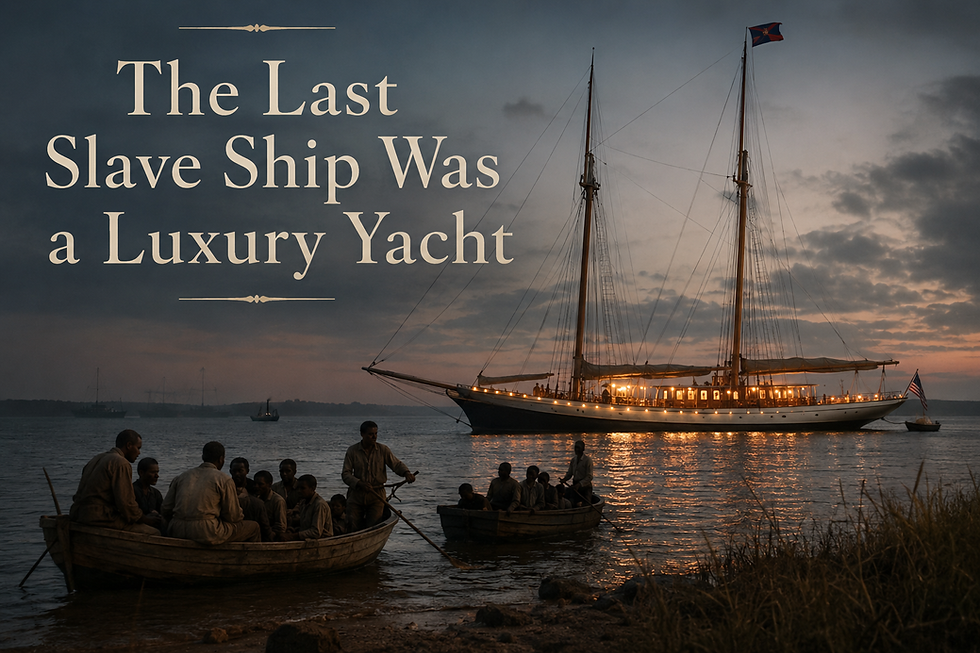
The Wanderer wasn’t a vessel designed to disappear into obscurity. It was a sleek and expensive yacht associated with wealthy Southern elites whose social standing, financial resources, and political connections provided significant protection from scrutiny. Those involved in the expedition relied on deception, counterfeit documentation, and carefully cultivated influence to evade anti-slavery patrols and federal oversight. The successful arrival of hundreds of captive Africans on American soil revealed that the existence of a law didn’t necessarily guarantee its enforcement.
Federal investigators eventually uncovered substantial evidence linking the vessel and its owners to the smuggling operation. Witnesses provided testimony, documents were examined, and multiple prosecutions were pursued against individuals connected to the voyage. Despite what many observers viewed as compelling evidence, the trials failed to produce a single conviction, leaving many Americans questioning whether federal law could be effectively enforced in regions where powerful local interests opposed it.
The acquittals attracted national attention because they occurred during a period of growing political instability. The country was already deeply divided over slavery, territorial expansion and the balance of power between state and federal authority. The passage of the Fugitive Slave Act in 1850 had intensified tensions by requiring citizens and local authorities in free states to assist in the capture and return of escaped enslaved people. Many Northerners who had previously viewed slavery as a distant Southern institution suddenly found themselves directly involved in its enforcement, leading to widespread resistance, legal challenges, and growing hostility toward the slave system.
At the same time, violence erupted in the Kansas Territory after the passage of the Kansas-Nebraska Act in 1854, which allowed settlers to decide for themselves whether slavery would be permitted. Pro-slavery and anti-slavery groups flooded into the territory in an effort to influence the outcome, producing years of intimidation, voter fraud, armed conflict, and political chaos. The conflict became known as “Bleeding Kansas” and convinced many Americans that compromise between the two sides was becoming increasingly difficult to achieve through ordinary political means.
The Supreme Court further deepened the crisis with its 1857 decision in the Dred Scott case. The Court ruled that Black Americans, whether enslaved or free, couldn’t be citizens of the United States and therefore had no standing to sue in federal court. The decision also declared that Congress lacked the constitutional authority to prohibit slavery in federal territories, effectively opening the possibility of slavery’s expansion into areas where many Americans had hoped it would be restricted. Rather than settling the slavery debate, the ruling intensified fears throughout the North that slaveholding interests were gaining greater control over national institutions.
Against this backdrop, the inability to secure convictions in the Wanderer case became another indication that the nation’s institutions were struggling to address increasingly serious conflicts over slavery and power. For many Americans, the acquittals reinforced the perception that federal laws related to slavery could be ignored or unevenly enforced when powerful interests stood to benefit, further eroding confidence in the government’s ability to manage the growing sectional divide. Against that backdrop, the inability to secure convictions in the Wanderer case became another indication that the nation’s institutions were struggling to address increasingly serious conflicts over slavery and power.
For many Americans, the significance of the case extended well beyond the illegal voyage itself. The proceedings raised fundamental questions about whether federal authority could be exercised consistently when local political and economic interests stood in opposition. The outcome suggested that even when violations were visible, documented, and publicly known, accountability could remain elusive if influential individuals possessed the resources and support necessary to resist prosecution.
The history of the Wanderer also challenges a common assumption about how social and political progress occurs. Historical narratives often treat legislation as the decisive moment when a problem has been solved, creating the impression that legal reform automatically produces meaningful change. The events surrounding the Wanderer reveal a far more complicated reality in which the passage of a law represents only one step in a much longer process.
By 1858, the federal ban on the transatlantic slave trade had existed for half a century, yet hundreds of Africans were still illegally transported into the United States through a scheme organized by prominent and well-connected individuals. The failure to hold anyone accountable exposed a persistent gap between legal principle and practical enforcement, demonstrating that laws can lose much of their power when institutions lack either the ability or the willingness to apply them consistently.
That tension between legislation and enforcement appears repeatedly throughout American history. Constitutional amendments established citizenship and voting rights for formerly enslaved people after the Civil War, yet organized violence, intimidation, and political resistance often prevented those rights from being fully exercised. Civil rights legislation dismantled legal segregation during the twentieth century, yet disparities in housing, education, wealth, and political representation continued to shape everyday life. Across different eras, legal victories frequently marked the beginning of new struggles rather than their conclusion.
The Wanderer remains historically significant because it illustrates how systems function when enforcement becomes selective and accountability is unevenly applied. The case demonstrates how wealth, social status, and political influence can shape outcomes even when evidence of wrongdoing appears substantial. It also reveals how public confidence in institutions can erode when laws seem to operate differently depending on who is accused of violating them.
As the nation moved closer to civil war, the voyage became one of many events that exposed the growing inability of existing political institutions to resolve conflicts surrounding slavery. The acquittals didn’t create those divisions, but they highlighted them in a way that made the weaknesses of the political system increasingly difficult to ignore. The case offered a stark example of the widening gap between federal authority and local resistance, a conflict that would soon erupt into a much larger national crisis.
More than 160 years later, the story of the Wanderer continues to offer insight into the relationship between law, power, and accountability. Legal standards establish expectations for society, but their effectiveness ultimately depends on institutions willing to enforce them and communities willing to support that enforcement. When those conditions are absent, even the most clearly written laws can become vulnerable to manipulation, resistance, and selective application.
The history of the Wanderer therefore serves as a reminder that justice can’t be measured solely by the laws a society places on its books. A more meaningful measure can often be found in whether those laws are applied consistently, whether powerful individuals are held to the same standards as everyone else, and whether institutions possess both the capacity and the commitment to uphold the principles they claim to defend.
If you’re interested in the historical patterns that connect past events to present-day debates about power, accountability, and justice, consider subscribing to Smart Brown Girl. I explore the moments that often receive only a brief mention in history classes, examining how institutions function, how narratives are shaped, and why certain struggles continue to reappear across generations.
-Smart Brown Girl


Comments