
America’s Anniversaries Were Never Neutral
America's Anniversaries Part 1
Most Americans are taught to think about national anniversaries as celebrations. We picture fireworks, patriotic speeches, school assemblies, historical reenactments, and familiar reminders about freedom and democracy. After reading America, U.S.A.: How Race Shadows the Nation’s Anniversary, I don’t think America’s anniversaries function as celebrations in the simple way many people imagine. They operate more like storytelling exercises that reveal which version of America the country wants to project at a particular moment in time and, just as importantly, which realities it wants pushed out of view.

That framework completely changes how you look at the country approaching its 250th anniversary. The book examines several major anniversaries in American history, particularly 1876, 1926, and 1976. What becomes clear almost immediately is that each celebration reflected the racial anxieties, political priorities, and cultural tensions of its own era rather than some neutral expression of national unity.
The 1876 Centennial took place as Reconstruction was collapsing. Black Americans had recently gained citizenship, voting rights, and political representation following the Civil War, but white backlash was accelerating violently across the South. Federal protections weakened, racial terror increased, and many white Americans increasingly treated Black political participation itself as a threat. The Centennial celebrated national unity at the exact moment the country was retreating from protecting Black freedom in practice.
According to Eddie S. Glaude Jr., reunion between white Americans in the North and South became more politically important than protecting Black citizenship. Slavery and racial violence had to be softened, minimized, or erased because acknowledging them too honestly would have disrupted the patriotic narrative the country wanted to tell about itself.
The 1926 Sesquicentennial reflected a different political moment but followed a remarkably similar pattern. The Ku Klux Klan had reemerged as a major political and cultural force. Immigration restrictions hardened, “America First” politics expanded, and white Protestant nationalism increasingly presented itself as patriotism rather than extremism. Once again, the anniversary reflected the politics of its era. Black Americans were largely excluded from planning and recognition while the country projected an image of spiritual unity and national innocence.
The 1976 Bicentennial unfolded under different circumstances because the Civil Rights Movement had already forced the country to confront segregation and racial violence more publicly. At the same time, the Vietnam War and the Watergate scandal had badly damaged public confidence in government and national morality. Even then, many official celebrations still relied heavily on what Glaude describes as “storybook America,” a version of the country that emphasizes inevitable progress while minimizing structural inequality, backlash, and unresolved conflict.
One of the most striking examples from that period remains The Soiling of Old Glory, the photograph showing a white teenager assaulting a Black man with an American flag during anti-busing protests in Boston. The image exposed the contradiction underneath so much patriotic rhetoric at the time. The flag represented freedom in theory while being used as a weapon against racial integration in practice.
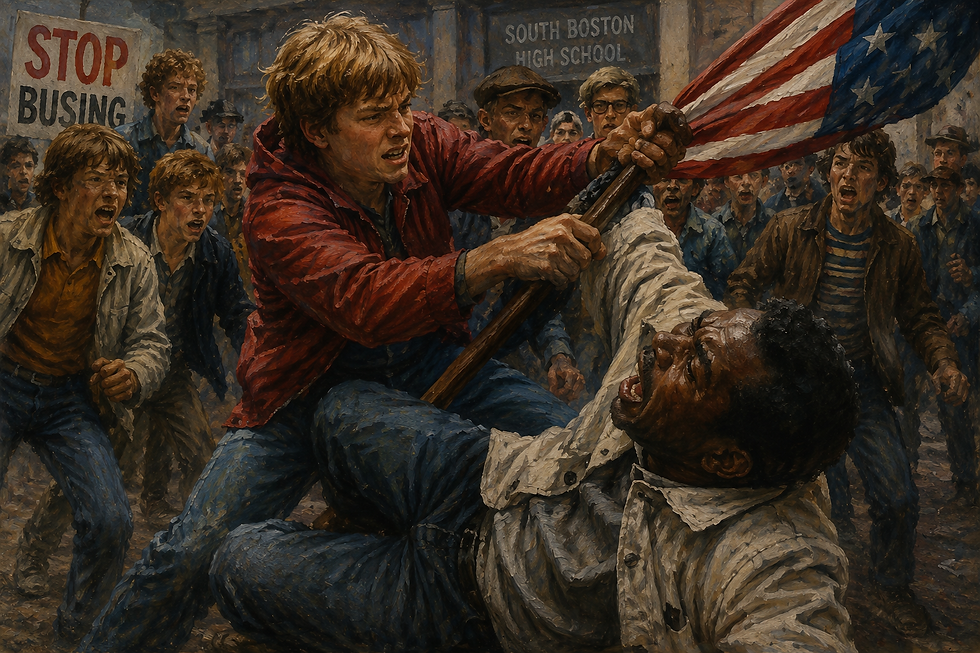
America repeatedly celebrates liberty while continuing to struggle with the question of who fully belongs within that promise.
The fights happening now over DEI, book bans, the 1619 Project, “patriotic education,” and how slavery is discussed in schools aren’t disconnected cultural debates. They’re arguments over national memory and competing ideas about who gets to define patriotism itself. History suggests those conflicts intensify whenever the country reaches moments of symbolic self-reflection like major anniversaries.
The deeper question underneath all of this is whether the country can tell a more honest story about itself without treating honesty as betrayal. That tension has existed from the beginning, and according to Glaude, America still hasn’t fully resolved it.
If this article challenged the way you think about American history, I highly recommend reading America, U.S.A.: How Race Shadows the Nation’s Anniversary for yourself. The book offers an important framework for understanding how national celebrations often reveal as much about the present as they do about the past.
For readers who want to go deeper, I’ve created additional resources that explore many of the themes discussed here, including Reconstruction, Jim Crow, civil rights backlash, historical memory, media narratives, and the ongoing debates over who gets to define American identity.
🔎 Explore more resources:
Follow Smart Brown Girl across platforms.
As America approaches its 250th anniversary, the question isn’t simply what we’re celebrating. The deeper question is which stories are being remembered, which stories are being forgotten, and what those choices reveal about who we are today.
-Smart Brown Girl


Comments