
America Has Paid Reparations Before. Why Not for Slavery?
The United States has acknowledged historical injustice and provided compensation before. Its record raises an important question about how governments decide which harms deserve repair.
There’s something about the way people discuss slavery in America that has always bothered me. We’re regularly told that slavery happened a long time ago, that nobody alive today owned enslaved people, and that Black Americans need to stop dwelling on the past. I’ve even had people tell me in my comments that we should stop feeling sorry for ourselves. It’s frustrating to hear the same dismissive arguments repeated when the historical consequences of slavery and the policies that followed are well documented.
I understand that people disagree about reparations. There are legitimate questions about eligibility, funding, and what an effective national program would look like. I’m willing to have those conversations because they deserve serious consideration. Saying that nobody alive today was enslaved or owned enslaved people doesn’t address the issue of government responsibility. The United States has compensated people for historical wrongdoing before, sometimes decades after the original injustice occurred. If we’re going to debate reparations, we should at least begin with an accurate understanding of that history.
The United States Has Already Paid Reparations
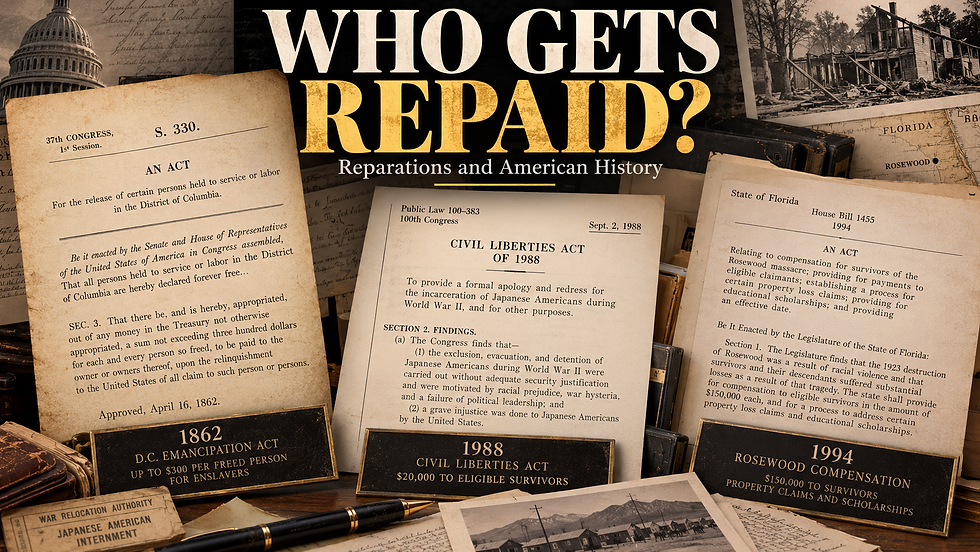
In 1988, President Ronald Reagan signed the Civil Liberties Act, formally acknowledging the federal government’s mistreatment of Japanese Americans during World War II. Following the attack on Pearl Harbor, approximately 120,000 people of Japanese ancestry, most of whom were American citizens, were forcibly removed and incarcerated. Families lost homes, businesses, income, and their freedom because of government decisions.
A federal commission later concluded that the incarceration resulted from racial prejudice, wartime hysteria, and a failure of political leadership rather than military necessity. The Civil Liberties Act authorized an official apology and $20,000 for eligible individuals. By the time the redress program closed, the Department of Justice reported that more than $1.6 billion had been distributed to over 82,000 recipients.
The compensation couldn’t restore everything families lost, and many people who experienced the injustice died before the legislation passed. Nevertheless, the government acknowledged its responsibility and provided a financial remedy more than forty years later.
What stands out to me is the acknowledgment itself. Compensation matters, but so does a government’s willingness to formally recognize the harm its policies caused. We know slavery existed, and we know discriminatory laws followed emancipation. Yet recognizing those historical facts hasn’t produced a comprehensive federal process for addressing their accumulated consequences.
Rosewood Shows That Reparations for Black Americans Aren’t Unprecedented
In January 1923, a white mob attacked Rosewood, a predominantly Black community in Florida. Residents were murdered, homes and businesses were destroyed, and surviving families fled. Many never recovered the property or economic security they lost.
In 1994, Florida authorized approximately $2.1 million in compensation related to the massacre. The legislation provided payments of up to $150,000 for qualifying survivors, established a process for property-loss claims, and created educational scholarship opportunities.
Rosewood demonstrates that a government can acknowledge racial violence against Black Americans and establish a compensation program generations later. It wasn’t a national slavery reparations program, and the circumstances were different. Florida was responding to a specific massacre involving identifiable survivors and property losses. Still, the state recognized that the passage of seventy years didn’t eliminate the need to address what had happened.
Germany Established Compensation Programs After the Holocaust
The international record provides another example. In 1952, West Germany signed agreements addressing material losses connected to Nazi persecution, including arrangements with Israel and the Conference on Jewish Material Claims Against Germany. Additional compensation and restitution programs developed over subsequent decades.
I don’t want to romanticize those efforts. Survivors faced resistance, complicated eligibility requirements, and prolonged negotiations. Compensation couldn’t replace the people who were murdered or erase the suffering survivors experienced. Other communities persecuted under Nazi rule also faced difficulties obtaining recognition and adequate remedies.
The relevant point is that governments have developed legal and financial mechanisms to acknowledge historical responsibility. These programs differed considerably, and none offers a complete model for slavery reparations in the United States. They do, however, demonstrate that the passage of time doesn’t automatically prevent governments from addressing historical wrongdoing.
America Once Compensated Enslavers
One of the most revealing examples comes from emancipation itself. On April 16, 1862, President Abraham Lincoln signed legislation abolishing slavery in Washington, D.C., freeing approximately 3,100 people. The law also authorized payments of up to $300 per freed person to qualifying enslavers who demonstrated loyalty to the Union.
The federal government ultimately spent nearly $1 million compensating former enslavers. The people who had endured forced labor didn’t receive equivalent restitution for their enslavement. Although the law included voluntary emigration assistance, those payments served a different purpose.
The legislation reflected a legal system that had recognized human beings as property. When slavery ended in the nation’s capital, the government created a financial remedy for people who had legally owned other human beings, rather than providing comparable restitution to the people who had been enslaved.
That decision tells us something about whose losses the government recognized. Emancipation ended the legal condition of enslavement, but it didn’t compensate formerly enslaved families for their labor or provide them with the resources needed to establish economic independence.
The Consequences Continued After Emancipation
The end of slavery transformed American law, but formerly enslaved people entered freedom with limited access to land, capital, and economic resources. During Reconstruction, Black Americans established schools, businesses, churches, newspapers, and political institutions. They participated in government and worked to expand the opportunities that slavery had denied them.
Those gains were challenged by racial violence, discriminatory legislation, political resistance, and the withdrawal of federal protections. Later government policies affecting housing, education, lending, employment, and public services continued to influence economic opportunity.
Property ownership offers a clear example of how these decisions could affect subsequent generations. Families able to purchase homes, accumulate equity, and transfer property to their children gained opportunities to build wealth. Families excluded from property ownership or denied fair access to lending faced different economic circumstances, even after discriminatory practices were formally prohibited.
That doesn’t mean every present-day racial disparity has one historical cause. Economic outcomes are shaped by multiple factors. But it does mean that historical government decisions remain relevant when examining differences in wealth, opportunity, and access to resources today.
The question isn’t whether slavery is still legal. It isn’t. The question is how the institutions and policies that developed during and after slavery influenced the conditions people inherited, and what responsibility the government has for those outcomes.
The National Reparations Debate Remains Unresolved
Congress has considered proposals to study slavery reparations for decades. H.R. 40 was first introduced in 1989, and legislation introduced in the 119th Congress proposes establishing a commission to examine slavery, subsequent racial discrimination, their continuing effects, and potential remedies.
The proposal doesn’t immediately authorize payments. It would establish a process for investigating the historical record and recommending possible responses.
A national reparations program would raise difficult questions about eligibility, the harms being addressed, funding, and the appropriate forms of remedy. Some proposals emphasize direct compensation, while others consider restitution, targeted investments, or institutional reforms. These approaches involve different assumptions about responsibility and how historical harm should be measured.
I don’t think those disagreements should be dismissed. They deserve research, public discussion, and careful evaluation. But neither should we treat the difficulty of designing a program as a reason to avoid examining the underlying history.
Acknowledgment Is Where Repair Begins
I don’t believe discussing slavery or reparations requires treating every living American as personally responsible for what previous generations did. Individual guilt and government responsibility are different questions. Governments inherit laws, institutions, public assets, debts, and obligations. They also have the capacity to recognize wrongdoing committed under earlier administrations and determine whether remedies are appropriate.
The United States has made those decisions before. Japanese American redress and Rosewood compensation demonstrate different approaches to historical accountability. The 1862 compensated emancipation law demonstrates something else: even when slavery was being abolished, the government made deliberate decisions about whose financial losses deserved compensation.
These examples don’t prove that a particular national reparations proposal is the correct solution. They do establish that historical compensation isn’t an unfamiliar concept in American government.
That’s why I find the expectation that Black Americans should simply move on so troubling. We can acknowledge that slavery ended more than 160 years ago while also recognizing that emancipation didn’t erase the policies, institutions, and economic inequalities that developed afterward. Those are separate historical questions, and both deserve attention.
My final thought is this: I don’t believe America will truly do well until we’re willing to acknowledge the systemic injustice created by slavery and the ways it continued through government policy long after emancipation.
I’m not suggesting that acknowledgment alone will resolve every disparity or that compensation can undo generations of harm. But I don’t see how we can adequately address problems we refuse to examine in their full historical context. We can’t have a serious conversation about economic opportunity, wealth, education, or equality while treating the government decisions that helped shape those conditions as irrelevant.
For me, the first step is acknowledging the relationship between slavery, the systems that followed, and the consequences that remain. From there, we can debate what responsibility looks like, which remedies are appropriate, and how to evaluate whether those remedies work.
I believe America would be better served by having that conversation than by continuing to insist that the passage of time has already settled it.
Keep Recognizing the Patterns
At Smart Brown Girl, I examine how history, government decisions, and institutions continue to shape our lives. Understanding those connections helps us evaluate current debates with greater context and distinguish historical evidence from assumptions.
If you’d like to develop those skills, download my free Pattern Recognition Starter Challenge. You can also explore my video explainers on YouTube and join the conversation on Instagram, Threads, and Patreon.
-Smart Brown Girl


Comments