
The Difference Between Reform and Real Change
The Illusion of Progress Series
History often teaches us to look for moments of transformation. A law is passed, a barrier falls, a new leader takes office, or a public institution acknowledges a past wrong. These moments are important and they can represent genuine victories earned through years of struggle and sacrifice. However, history also shows that a visible reform doesn’t always mean that the underlying structures of power have fundamentally changed.
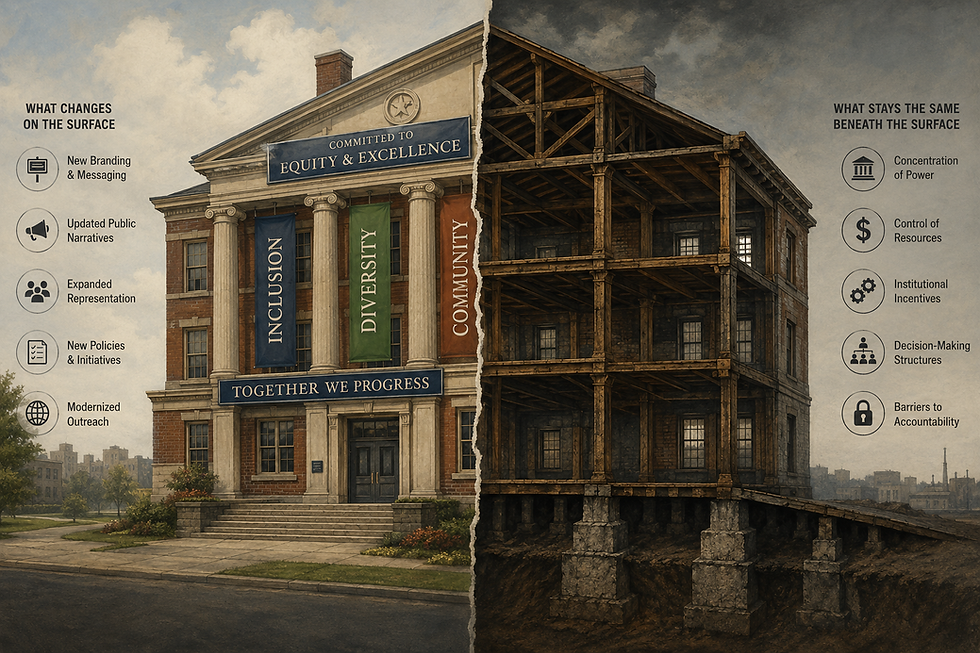
Many institutions survive challenges not by refusing to adapt, but by changing just enough to preserve their core interests. When old methods of maintaining power become unacceptable, unpopular, or legally impossible, new methods often emerge. Although institutions may adopt new language, revise their policies, and reshape their public image, the underlying distribution of power, resources, and decision-making authority may remain remarkably familiar.
Looking beyond symbolic change to examine whether institutions have undergone structural transformation is one of the most important tools for understanding history. Symbolic change often centers on visible signs of progress and public acknowledgment of past or present inequities. While these changes may alter how institutions present themselves and who is represented within public narratives, they don’t necessarily transform the systems that determine power and opportunity. That doesn’t mean symbolic changes lack value. Greater visibility and recognition can expand people’s sense of belonging and challenge long-standing assumptions about who is seen, heard, and valued within society.
However, structural change requires examining whether the underlying systems that determine the distribution of power, resources, and opportunities have been transformed. It focuses on who holds decision-making authority and whether meaningful mechanisms exist to ensure institutions remain accountable beyond public statements or temporary initiatives. Structural change is ultimately measured by changes to the rules and structures that shape everyday outcomes.
American history provides countless examples of this tension. The abolition of slavery ended the legal ownership of human beings, but it was followed by the rise of Black Codes, convict leasing, and eventually Jim Crow segregation, systems that developed new mechanisms for controlling Black labor and limiting Black freedom. The victories of the Civil Rights Movement dismantled legal segregation and expanded political rights, but the struggle over equality didn’t end. Instead, it shifted into new arenas where the distribution of resources, access, and institutional power continued to influence outcomes.
This pattern doesn’t mean that reforms are meaningless or that progress never occurs. The end of slavery and the passage of civil rights legislation represented significant achievements, while expanded access to education, employment, and political participation created opportunities that transformed millions of lives. At the same time, historical progress has rarely moved in a straight line. Advances are often met with resistance from individuals and institutions that see reforms as a threat to existing arrangements of power.
Backlash isn’t simply a disagreement over policy. Throughout history, backlash has frequently been a strategy for restoring lost influence, redefining the terms of a debate, or creating new systems that protect old hierarchies under a different name. It can appear through legal challenges, political movements, shifts in public narratives, economic restructuring, or efforts to limit the scope of reforms.
Recognizing these patterns allows us to move beyond simple questions of whether society has changed and toward more meaningful questions about how it has changed. Progress should be measured not only by what is promised or celebrated, but also by what is implemented, enforced, and sustained over time.
The true measure of progress isn’t simply whether a reform has been announced, but whether it has changed how power operates within institutions, whether resources and opportunities are more equitably distributed, and whether accountability exists to ensure those changes endure beyond moments of public pressure.
History suggests that lasting transformation requires more than a shift in language or symbolism. It requires changes to the structures that determine whose voices are heard, whose interests are protected, and who has the ability to shape the future. The challenge isn’t simply recognizing when institutions change. The deeper challenge is determining whether they have changed in ways that alter the balance of power, or whether they have merely found a new way to maintain it.
If this article changed the way you think about progress and institutional change, the next step is learning how to recognize these patterns in real time. Download my free Pattern Recognition Starter Guide to explore the historical frameworks, questions, and analytical tools that will help you understand how systems adapt, how backlash operates, and how narratives shape public understanding.
-Smart Brown Girl


Comments