
The “Superstitions” We Inherited Were Not Random
Many of the behaviors often described as superstitions in Black communities are treated as if they appeared without context, framed as habits passed down without explanation, sometimes followed, sometimes dismissed. This framing, however, misses something important: these practices didn’t emerge in neutral conditions. They developed in environments where people had limited control over their safety, their movement, and their access to resources. Under such constraints, behavior becomes intentional, and small actions carry significant weight as patterns form around reducing risk.
What gets labeled as superstition is often the residue of these adaptive patterns. For instance, consider the caution around sweeping over someone’s feet, which is sometimes believed to prevent marriage or future prosperity. On the surface, this may appear as a quirky belief, but in contexts where economic security and social bonds were fragile, maintaining order in the home and respecting boundaries could serve as subtle ways of preserving dignity and hope for stability.
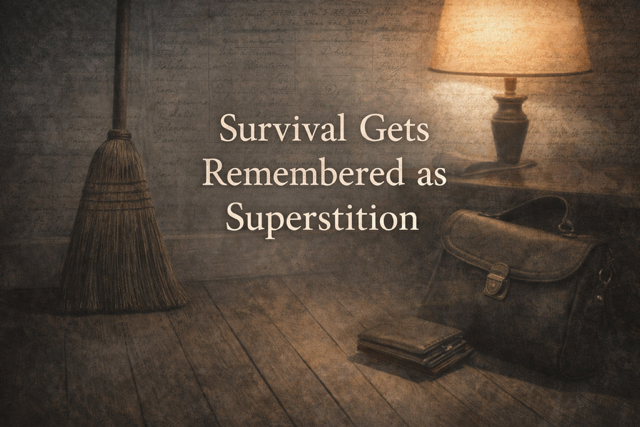
Behaviors related to visibility and attention also reflect this logic. The widespread practice of limiting movement at night, for example, once functioned as a practical response to environments where surveillance and punishment were constant threats. Avoiding being seen after dark wasn’t an abstract fear; it was a calculated measure to reduce the risk of harm. Even the tradition of knocking on wood after speaking hopefully or guarding one’s words about the future can be traced to situations were information, if overheard or misused, could bring danger. Being careful about what one says or who overhears becomes a form of protection, which over time may be reframed as a belief in speaking outcomes into existence.
Resource protection is similarly embedded in these practices. Habits such as not putting one’s purse or wallet on the floor, commonly believed to bring financial misfortune, take on a new meaning when viewed in the context of chronic instability and limited access to resources. In a world defined by scarcity, strict rules around money and possessions aren’t excessive, but practical measures for survival.
As these behaviors are passed down, the specific conditions that produced them aren’t always carried forward with the same clarity. The actions remain, while the explanations fade. Once that happens, interpretation shifts, and practices are often dismissed as irrational or romanticized without genuine understanding. In both cases, the connection to the circumstances that shaped them is lost.
This loss matters because it changes how culture is understood and how history is remembered. When adaptive behaviors are separated from the systems that required them, those systems become less visible. Recognizing the origins of these practices doesn’t mean treating them as fixed or unchangeable but understanding them accurately. They aren’t random or disconnected from history; instead, they are evidence of how people responded to specific conditions, responses that are still visible today.
For deeper historical breakdowns and context follow Smart Brown Girl:
Watch the full video on YouTube
Follow along on Instagram for short-form content
Read the full essays on Substack
Support the work and access deeper analysis on Patreon
-Smart Brown Girl


Comments