
How American Schools Were Built to Separate and Starve
They didn’t forget to fix the schools. This was the plan.
When we talk about failing schools, underperforming districts, or the achievement gap, the conversation usually centers on students, teachers, or families. What we rarely examine is architecture. Not brick and mortar, but financial design. The structure that determines who gets resources, who gets stability, and who is expected to make do.
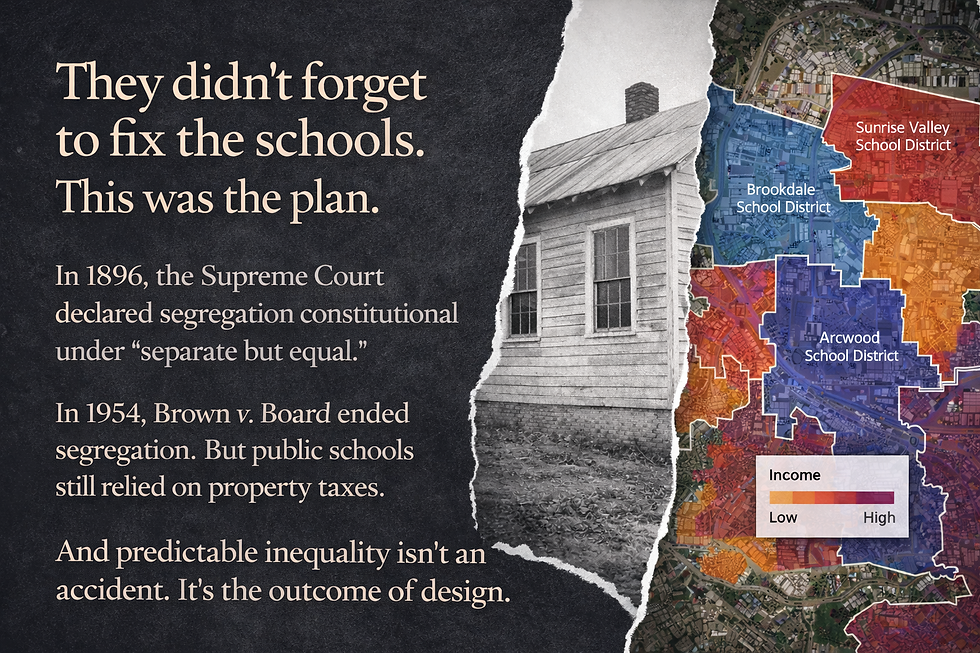
In 1896, the Supreme Court declared segregation constitutional under the doctrine of “separate but equal.” It was a legal fiction that gave inequality official cover. Black schools weren’t just separate; they were deliberately underfunded, overcrowded, and deprived of basic materials. The disparity wasn’t incidental. It was written into law and enforced through budgets.
When Brown v. Board of Education overturned formal school segregation in 1954, it dismantled the legal language of separation. What it didn’t dismantle was the funding model underneath it. Public education in the United States continued to rely heavily on local property taxes. That meant that access to educational opportunity remained tied to neighborhood wealth.
By then, housing policy had already shaped where wealth could accumulate. Redlining denied mortgages to Black families in entire neighborhoods. Racially restrictive covenants barred homeownership in others. Federal lending practices fueled suburban expansion for white families while systematically excluding Black families. As property values rose in some communities and stagnated in others, school funding rose and stagnated with them.
District lines began to function as modern segregation lines. They looked neutral on paper, but they tracked with patterns created by decades of discriminatory housing policy. As court-ordered integration weakened in the late twentieth century, segregation didn’t disappear. It re-emerged through boundary decisions, school zoning, and the quiet logic of property-based funding.
This isn’t a story about individual failure. It’s not about blaming teachers who are asked to do more with less, or parents navigating constrained options. It’s about recognizing that when educational opportunity is tied to property wealth, inequality becomes predictable.
And predictable inequality isn’t an accident.
It’s the outcome of design.
If this breakdown helped you understand the structure behind school inequality, follow Smart Brown Girl on YouTube for full policy deep dives, on TikTok and Instagram for daily context, and subscribe to Substack for extended analysis and classroom-ready resources.
Full YouTube video here.
Smart Brown Girl


Comments